

Itecor · 13. Februar 2026
AI-based chatbots have found their place in many companies. They have become a fast gateway to information and an effective way to save time on repetitive tasks. Recently, a new stage has begun with AI agents. These are no longer just assistants that respond, but systems capable of executing actions and coordinating processes.
For our customers and for ourselves, keeping up with this evolution is essential. It directly affects the way services are delivered and managed. Intelligent agents can reduce the workload of support teams, improve the reliability of critical processes and speed up incident response. They also raise questions of governance, security and adoption. Ignoring this trend risks leaving your organisation stuck with rigid automation models while the market advances towards more responsive and integrated services.
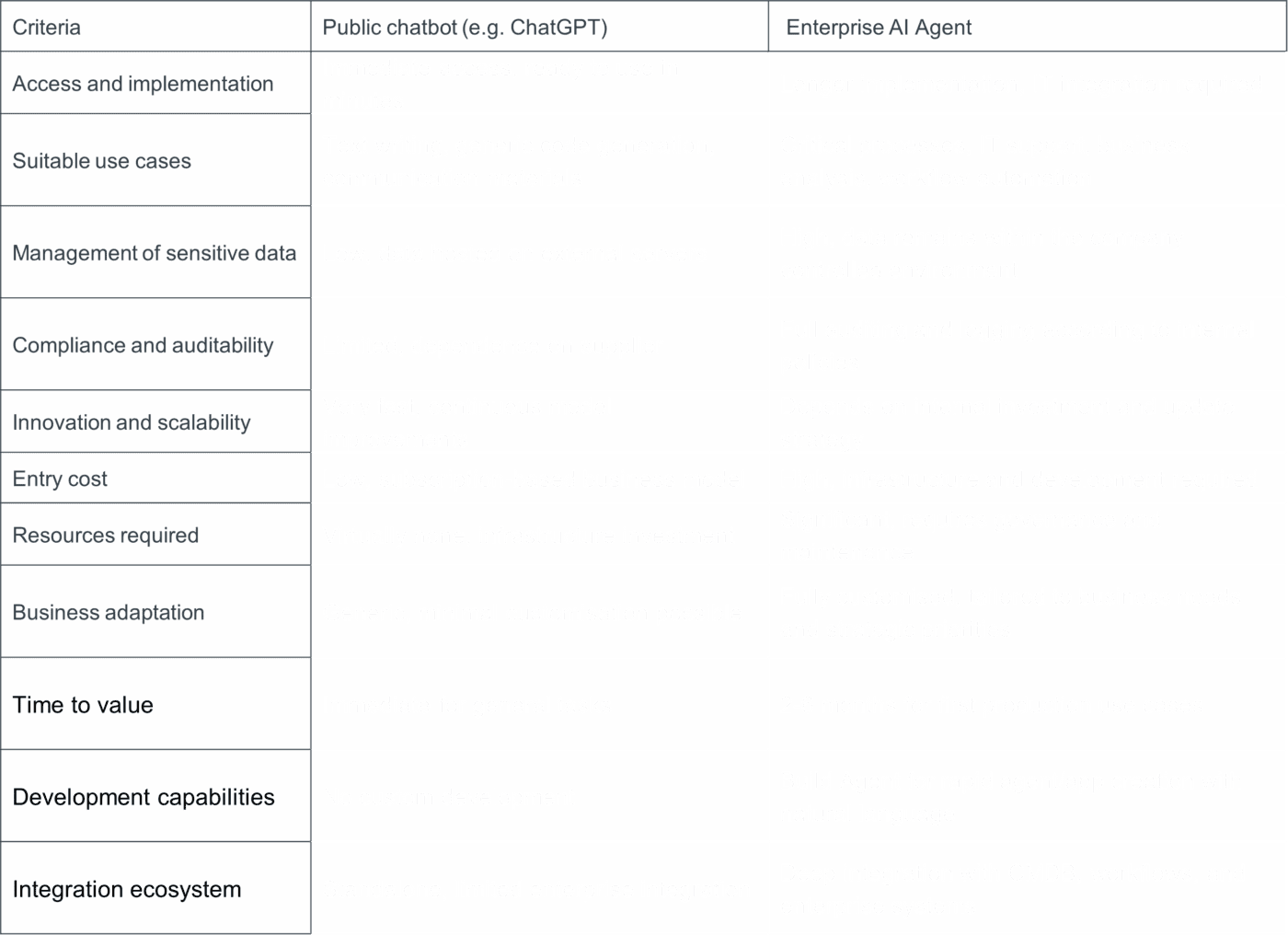
Comparing a public chatbot with an in-house chatbot helps identify where the real value levers lie. The table below helps distinguish the immediate benefits of external solutions from the long-term advantages of in-house development.
A chatbot answers a question. An agent can take the initiative to act. In ServiceNow’s approach, agents are orchestrated, specialised by domain and connected to business tools. They rely on a cross-functional data layer to avoid silos.
Typically, ServiceNow already integrates agentic AI with the Now Assist module, which enables the use of agentic workflows and AI agents. Each release brings a host of major improvements, and Zurich, released last October, is no exception, with ever more impressive features. We will be sure to revisit these features in a future publication and share with you the feedback from a pilot project we are currently conducting in collaboration with a client.
Here, we focus on Now Assist to illustrate the potential of AI agents in a structured IT environment. However, other platforms, technologies and partners may be just as relevant depending on the needs, maturity and ecosystem of each organisation. As a trusted advisor, Itecor supports its clients by choosing the solution best suited to their challenges and working with them to build a technological roadmap that will maximise the value created.
The chatbot remains the user-facing interface, while the real work happens behind the scenes. The agent can monitor an environment, trigger scripts, open a ticket or notify a manager without waiting for a question to be asked.
From a strategic point of view, this changes the role of IT services: they are no longer limited to providing tools, but implement active automation that reduces dependence on human intervention. This improves responsiveness to incidents, reduces downtime costs and creates long-term value by making processes more reliable.
Support teams no longer have to manage all first-level requests, as some of them are handled directly by agents. Workflows are executed without interruption and technicians can focus on more complex cases. This promotes better service quality, shorter resolution times and more rewarding work for operational teams.
Agentic AI refers to systems capable of understanding a goal, breaking it down into tasks, and then mobilising software tools (APIs, browsers, databases, etc.) to execute those actions. Unlike traditional chatbots or automations, these agents can adapt in real time to the results they obtain, bringing them closer to being autonomous digital collaborators.
The value of agentics is best measured in practice. Here are a few situations where a chatbot combined with intelligent agents is transforming the way IT services operate.
Support teams often deal with repetitive issues such as blocked access or minor errors. An AI agent can detect the alert, create a ticket and apply a standard resolution. This reduces the workload at the first level and allows technicians to focus on complex cases. Beyond automating diagnosis and proposing solutions, a key advantage lies in the ability of AI agents to quickly analyse the sometimes voluminous history of incidents and then produce a clear and actionable summary in a few lines. This time saving for teams not only facilitates case handling, but also enables the generation of structured and relevant knowledge bases. These will be crucial to the adoption and effectiveness of AI agents, ensuring responses tailored to the specific context of the customer and their platform environment.
When a critical service goes down, responsiveness is key. An AI agent can run immediate diagnostics, analyse the impact and alert the right teams. While the automation of corrective measures is still limited in practice (most organisations require human approval before taking any action on a major incident), AI will nevertheless play a decisive role in executing the first steps. It will be able to prepare corrective actions, propose the most likely remediation scenarios and orchestrate the response by mobilising the right experts. This will enable decisions to be made more quickly, while maintaining the necessary human control, which will significantly improve the effectiveness of crisis management.
Onboarding a new employee involves many scattered steps. An AI agent can automatically create accounts, configure access and answer initial questions via chat. The employee will be operational more quickly and their onboarding experience will be smoother.
Collecting indicators will remain a long and tedious process if done manually. An AI agent can consolidate data, check its consistency and generate a clear summary. Managers will save time and have a report ready for decision-making.
Giving more autonomy to an AI agent raises important questions. At Itecor, we have developed accelerators that allow us to anticipate these questions from the outset of a project. We work with structured checklists that cover strategy, security and operational adoption.
Among the topics covered:
Scope of authorised actions: which tasks can the agent perform on its own and which require human validation?
Traceability: how are the agents' decisions and actions logged and audited?
Data security: which data sources can the agent use and with what level of access?
Adoption by teams: which use cases should be tested in a pilot before large-scale deployment?
A typical excerpt from our checklist:
Is the AI agent's persona correctly configured to limit its access to only the necessary data and actions?
Is there a human validation mechanism for its actions in sensitive or critical scenarios?
Do users clearly understand what the agent is and is not authorised to do?
Are the agent's access rights and permissions reviewed regularly?
Are the agent's actions tracked and auditable?
This structured approach reduces risk while accelerating the implementation of agentic AI in IT services.
AI chatbots have already changed the way we access information. The next step will be more demanding: agents capable of acting within systems and orchestrating entire processes. This is not a distant scenario, but an evolution that is already underway.
At Itecor, we see two main conditions for this automation to deliver on its promises. First, knowing where it brings real value and where it must remain under human control . Second, establishing clear rules from the outset, with tools and methodologies that avoid blind spots in terms of security, data and adoption.
The question is therefore not „should we go ahead with it“, but „how can we frame this adoption in a way that enhances the reliability and efficiency of services“. It is in this area that agentic AI can become a real performance lever.
| Cookie | Dauer | Beschreibung |
|---|---|---|
| IDE | 1 year 24 days | Google DoubleClick IDE-Cookies werden verwendet, um Informationen darüber zu speichern, wie der Nutzer die Website nutzt, um ihm relevante Werbung entsprechend seinem Profil zu präsentieren. |
| test_cookie | 15 Minuten | Der test_cookie wird von doubleclick.net gesetzt und dient dazu, festzustellen, ob der Browser des Benutzers Cookies unterstützt. |
| VISITOR_INFO1_LIVE | 5 Monate 27 Tage | Ein Cookie, das von YouTube gesetzt wird, um die Bandbreite zu messen, die bestimmt, ob der Nutzer die neue oder die alte Playeroberfläche erhält. |
| YSC | Session | Das YSC-Cookie wird von Youtube gesetzt und dient dazu, die Aufrufe von eingebetteten Videos auf Youtube-Seiten zu verfolgen. |
| Cookie | Dauer | Beschreibung |
|---|---|---|
| __hstc | 1 Jahr 24 Tage | Dies ist das Haupt-Cookie, das von Hubspot gesetzt wird, um Besucher zu verfolgen. Es enthält die Domäne, den ursprünglichen Zeitstempel (erster Besuch), den letzten Zeitstempel (letzter Besuch), den aktuellen Zeitstempel (dieser Besuch) und die Sitzungsnummer (wird bei jeder nachfolgenden Sitzung erhöht). |
| _ga | 2 Jahre | Das _ga-Cookie, das von Google Analytics installiert wird, berechnet Besucher-, Sitzungs- und Kampagnendaten und verfolgt auch die Nutzung der Website für den Analysebericht der Website. Das Cookie speichert Informationen anonym und weist eine zufällig generierte Nummer zu, um eindeutige Besucher zu erkennen. |
| _ga_JYCPSB48B8 | 2 Jahre | Dieses Cookie wird von Google Analytics installiert. |
| CONSENT | 16 Jahre 2 Monate 25 Tage 10 Stunden | YouTube setzt dieses Cookie über eingebettete YouTube-Videos und registriert anonyme statistische Daten. |
| hubspotutk | 1 Jahr 24 Tage | Dieses Cookie wird von HubSpot verwendet, um die Besucher der Website zu verfolgen. Dieses Cookie wird bei der Übermittlung eines Formulars an Hubspot weitergegeben und bei der Deduplizierung von Kontakten verwendet. |
| Cookie | Dauer | Beschreibung |
|---|---|---|
| __cf_bm | 30 Minuten | Dieses Cookie wird von Cloudflare gesetzt und dient der Unterstützung des Cloudflare Bot Management. |
| __hssc | 30 Minuten | HubSpot setzt dieses Cookie, um Sitzungen zu verfolgen und um zu bestimmen, ob HubSpot die Sitzungsnummer und die Zeitstempel im __hstc-Cookie erhöhen soll. |
| Cookie | Dauer | Beschreibung |
|---|---|---|
| __hssrc | Session | Dieses Cookie wird von Hubspot immer dann gesetzt, wenn es das Sitzungscookie ändert. Das __hssrc-Cookie, das auf 1 gesetzt ist, zeigt an, dass der Benutzer den Browser neu gestartet hat, und wenn das Cookie nicht existiert, wird angenommen, dass es sich um eine neue Sitzung handelt. |
| _GRECAPTCHA | 5 Monate 27 Tage | Dieses Cookie wird vom Google-Recaptcha-Dienst gesetzt, um Bots zu identifizieren und die Website vor bösartigen Spam-Angriffen zu schützen. |
| cookielawinfo-checkbox-advertisement | 1 Jahr | Dieser Cookie wird vom GDPR Cookie Consent Plugin gesetzt und dient dazu, die Zustimmung des Nutzers zu den Cookies der Kategorie "Werbung" zu erfassen. |
| cookielawinfo-checkbox-analytics | 11 Monate | Dieses Cookie wird vom GDPR Cookie Consent Plugin gesetzt. Das Cookie wird verwendet, um die Zustimmung des Nutzers für die Cookies in der Kategorie "Analytics" zu speichern. |
| cookielawinfo-checkbox-functional | 11 Monate | Das Cookie wird durch die GDPR-Cookie-Zustimmung gesetzt, um die Zustimmung des Nutzers für die Cookies in der Kategorie "Funktional" zu erfassen. |
| cookielawinfo-checkbox-necessary | 11 Monate | Dieses Cookie wird vom GDPR Cookie Consent Plugin gesetzt. Das Cookie wird verwendet, um die Zustimmung des Nutzers für die Cookies der Kategorie "Notwendig" zu speichern. |
| cookielawinfo-checkbox-others | 11 Monate | Dieses Cookie wird vom GDPR Cookie Consent Plugin gesetzt. Das Cookie wird verwendet, um die Zustimmung des Nutzers für die Cookies in der Kategorie "Andere" zu speichern. |
| cookielawinfo-checkbox-performance | 11 Monate | Dieses Cookie wird vom GDPR Cookie Consent Plugin gesetzt. Das Cookie wird verwendet, um die Zustimmung des Nutzers für die Cookies in der Kategorie "Leistung" zu speichern. |
| viewed_cookie_policy | 11 Monate | Das Cookie wird vom GDPR Cookie Consent Plugin gesetzt und wird verwendet, um zu speichern, ob der Nutzer der Verwendung von Cookies zugestimmt hat oder nicht. Es speichert keine persönlichen Daten. |