

Interview with Helen Bally, Head of QA&T, and Paul Barnabé, Head of Itecor Suisse Romande · 20. April 2026
For more than ten years, Itecor has been supporting its customers in hybrid mode from Switzerland and North Macedonia. This organisation, combining proximity, flexibility and operational excellence, enables the delivery of high value-added managed services in areas such as testing, development and application management.
In this discussion with Helen Bally, Head of the Quality Assurance & Testing service line, and Paul Barnabé, Head of Itecor Suisse Romande, we look at the main advantages of this delivery model combined with nearshore, the business drivers that make it particularly relevant today, and the practical steps a company can take to start a Managed Service with Itecor.
The primary objective is often very concrete: to do better with less. Our clients seek to maintain the same level of service, or even improve it, while optimising their costs. The Managed Service model responds precisely to this need: it allows them to maintain operational quality equivalent to or superior to that of an internal team, while introducing flexibility and budgetary visibility.
But beyond cost reduction, there is also a desire for peace of mind. Many IT organisations struggle to recruit and retain talent, whether in testing or development. By entrusting us with all or part of the service, they delegate the burden of recruitment, retention and management.
We become, in a way, their operational life insurance: they no longer have to manage turnover, profile availability or onboarding, as this is integrated into our model. Itecor manages the entire HR lifecycle of the service, from recruitment to training and retention, ensuring continuity without any additional burden on the client. The client also benefits from integrated technology monitoring and, if desired, management of their software factory tools or licences.
Several major players in Switzerland and France, in insurance, industry and public services, have already chosen this model with Itecor.
The first driver is, of course, budgetary. But other issues quickly follow: scalability and organisational complexity.
Let’s take a concrete example: a large digital transformation programme often involves several service providers, each with their own contacts and working methods. The client has to coordinate all of this, which generates a lot of internal workload. With a Managed Service, you can have a single supplier, clear governance and precise contractual commitments: delivery times, service continuity, compliance with SLAs, operational KPIs, etc.
This is what we call model scalability: the ability to quickly adapt resources to needs—with very short ramp-up times, often around one month—while maintaining a high level of efficiency, in other words, operational and budgetary performance.
Finally, in areas such as testing, Managed Services make it possible to guarantee functional coverage and monitor quality indicators such as the automation rate or the number of defects detected in production.
We are moving from a resource-based approach to a results–based approach.
A management structure – a dedicated delivery manager on the Itecor side and a point of contact on the client side – ensures transparency, strategic alignment and long-term value through regular committees and performance reviews.
Our approach is collaborative and iterative.
It all starts with an analysis phase: we identify stakeholders, gather documentation and assess the existing environment. Next, we define governance, processes, tools and a common service catalogue that clearly describes the services available, such as management, design and execution of functional and performance tests, and automation of regression or integration tests.
This phase is followed by an analysis of the application portfolio and ongoing projects, carried out jointly with the client. The aim is to determine the optimal capacity to be put in place (in terms of resources, skills and tools) for each functional area or product.
This fine-tuning process allows us to tailor the service to actual needs, avoid under- or over-capacity, and ensure efficient team allocation from the outset.
Once this framework is in place, we carry out a due diligence phase to test, adjust and validate the operating assumptions. Only after this stage do our formal SLA and KPI commitments take effect. Our commitments are structured around two families of indicators:
This dual approach enables objective and transparent service management, promoting continuous improvement and making Itecor accountable for results.
The client thus maintains a clear view of the value created, beyond simple resource monitoring.
The service is deployed in stages: takeover of a functional or application scope (ERP, CRM, finance, etc.), gradual ramp-up, then extension to other areas. It is a controlled, structured transition – one without any disruption to service.
Provision of staff; the client remains in charge of day-to-day operations.
Commitment to a specific deliverable, in line with deadlines, costs and budget.
Long-term commitment to performance, quality and continuity of service.
It’s our signature. We offer a European nearshoring model, but with a typically Swiss culture of quality and rigour. This translates into robust processes, transparency in relationships and a constant focus on customer satisfaction.
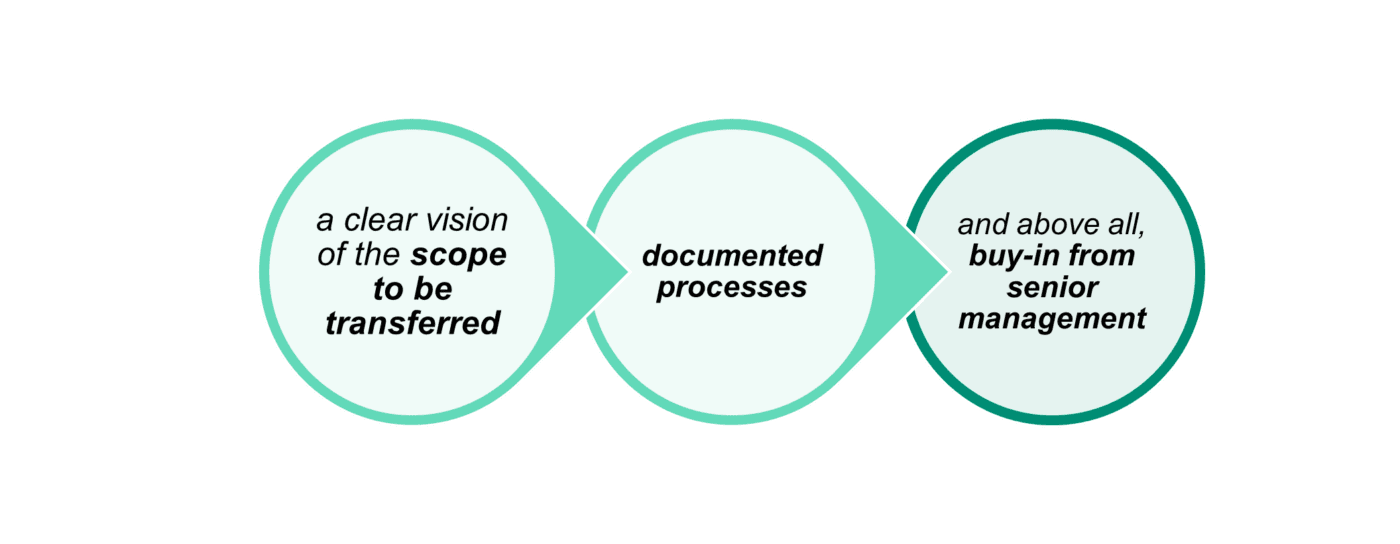
To be successful, a Managed Service must be supported by strong management sponsorship, clear governance and a long-term relationship of trust. This is what allows value to be anchored over time and makes the service a real performance lever.
Our Managed Services are built on Swiss standards of reliability and compliance: data confidentiality and security, compliance with personal data protection regulations (LPD, GDPR), and service continuity.
This is a strong commitment that is recognised by our customers.
Unlike simple resource outsourcing, we offer our customers a model based on efficiency, governance and lasting trust. A controlled, scalable and, above all, deeply human service. Swiss style.
| Cookie | Dauer | Beschreibung |
|---|---|---|
| IDE | 1 year 24 days | Google DoubleClick IDE-Cookies werden verwendet, um Informationen darüber zu speichern, wie der Nutzer die Website nutzt, um ihm relevante Werbung entsprechend seinem Profil zu präsentieren. |
| test_cookie | 15 Minuten | Der test_cookie wird von doubleclick.net gesetzt und dient dazu, festzustellen, ob der Browser des Benutzers Cookies unterstützt. |
| VISITOR_INFO1_LIVE | 5 Monate 27 Tage | Ein Cookie, das von YouTube gesetzt wird, um die Bandbreite zu messen, die bestimmt, ob der Nutzer die neue oder die alte Playeroberfläche erhält. |
| YSC | Session | Das YSC-Cookie wird von Youtube gesetzt und dient dazu, die Aufrufe von eingebetteten Videos auf Youtube-Seiten zu verfolgen. |
| Cookie | Dauer | Beschreibung |
|---|---|---|
| __hstc | 1 Jahr 24 Tage | Dies ist das Haupt-Cookie, das von Hubspot gesetzt wird, um Besucher zu verfolgen. Es enthält die Domäne, den ursprünglichen Zeitstempel (erster Besuch), den letzten Zeitstempel (letzter Besuch), den aktuellen Zeitstempel (dieser Besuch) und die Sitzungsnummer (wird bei jeder nachfolgenden Sitzung erhöht). |
| _ga | 2 Jahre | Das _ga-Cookie, das von Google Analytics installiert wird, berechnet Besucher-, Sitzungs- und Kampagnendaten und verfolgt auch die Nutzung der Website für den Analysebericht der Website. Das Cookie speichert Informationen anonym und weist eine zufällig generierte Nummer zu, um eindeutige Besucher zu erkennen. |
| _ga_JYCPSB48B8 | 2 Jahre | Dieses Cookie wird von Google Analytics installiert. |
| CONSENT | 16 Jahre 2 Monate 25 Tage 10 Stunden | YouTube setzt dieses Cookie über eingebettete YouTube-Videos und registriert anonyme statistische Daten. |
| hubspotutk | 1 Jahr 24 Tage | Dieses Cookie wird von HubSpot verwendet, um die Besucher der Website zu verfolgen. Dieses Cookie wird bei der Übermittlung eines Formulars an Hubspot weitergegeben und bei der Deduplizierung von Kontakten verwendet. |
| Cookie | Dauer | Beschreibung |
|---|---|---|
| __cf_bm | 30 Minuten | Dieses Cookie wird von Cloudflare gesetzt und dient der Unterstützung des Cloudflare Bot Management. |
| __hssc | 30 Minuten | HubSpot setzt dieses Cookie, um Sitzungen zu verfolgen und um zu bestimmen, ob HubSpot die Sitzungsnummer und die Zeitstempel im __hstc-Cookie erhöhen soll. |
| Cookie | Dauer | Beschreibung |
|---|---|---|
| __hssrc | Session | Dieses Cookie wird von Hubspot immer dann gesetzt, wenn es das Sitzungscookie ändert. Das __hssrc-Cookie, das auf 1 gesetzt ist, zeigt an, dass der Benutzer den Browser neu gestartet hat, und wenn das Cookie nicht existiert, wird angenommen, dass es sich um eine neue Sitzung handelt. |
| _GRECAPTCHA | 5 Monate 27 Tage | Dieses Cookie wird vom Google-Recaptcha-Dienst gesetzt, um Bots zu identifizieren und die Website vor bösartigen Spam-Angriffen zu schützen. |
| cookielawinfo-checkbox-advertisement | 1 Jahr | Dieser Cookie wird vom GDPR Cookie Consent Plugin gesetzt und dient dazu, die Zustimmung des Nutzers zu den Cookies der Kategorie "Werbung" zu erfassen. |
| cookielawinfo-checkbox-analytics | 11 Monate | Dieses Cookie wird vom GDPR Cookie Consent Plugin gesetzt. Das Cookie wird verwendet, um die Zustimmung des Nutzers für die Cookies in der Kategorie "Analytics" zu speichern. |
| cookielawinfo-checkbox-functional | 11 Monate | Das Cookie wird durch die GDPR-Cookie-Zustimmung gesetzt, um die Zustimmung des Nutzers für die Cookies in der Kategorie "Funktional" zu erfassen. |
| cookielawinfo-checkbox-necessary | 11 Monate | Dieses Cookie wird vom GDPR Cookie Consent Plugin gesetzt. Das Cookie wird verwendet, um die Zustimmung des Nutzers für die Cookies der Kategorie "Notwendig" zu speichern. |
| cookielawinfo-checkbox-others | 11 Monate | Dieses Cookie wird vom GDPR Cookie Consent Plugin gesetzt. Das Cookie wird verwendet, um die Zustimmung des Nutzers für die Cookies in der Kategorie "Andere" zu speichern. |
| cookielawinfo-checkbox-performance | 11 Monate | Dieses Cookie wird vom GDPR Cookie Consent Plugin gesetzt. Das Cookie wird verwendet, um die Zustimmung des Nutzers für die Cookies in der Kategorie "Leistung" zu speichern. |
| viewed_cookie_policy | 11 Monate | Das Cookie wird vom GDPR Cookie Consent Plugin gesetzt und wird verwendet, um zu speichern, ob der Nutzer der Verwendung von Cookies zugestimmt hat oder nicht. Es speichert keine persönlichen Daten. |