
HomeinsightsAI in the SDLC: Accelerating delivery without losing trust
quality assurance & testing

AI in the SDLC: Accelerating delivery without losing trust

Alexandre Thibaud, Senior Consultant at Itecor · November 19, 2000

AI does not reduce the need for quality. It changes where quality matters most across the SDLC. Teams spend less time creating artefacts and more time verifying that what is generated genuinely meets business needs, complies with expected requirements, and does not introduce new risks.

A promising prospect, certainly, but how can organisations leverage AI without losing control or confidence? Drawing on his hands-on experience, our expert shares the benefits observed in the field, the most common pitfalls, and the changes in practices that enable teams to take advantage of AI while maintaining high-quality standards.

To move beyond the promises and focus on practical realities, we spoke with Alexandre Thibaud, Quality Engineering & Testing Leader. For more than twenty years, he has helped organisations improve their software quality practices, from test automation to large-scale QA transformation.

His view is clear: AI is accelerating software delivery, but it is also increasing the need for a rigorous approach to quality, risk management, and governance.

Before AI tools arrived, what did a typical week look like? Where did most of your time go?

Honestly, a large share went into producing and maintaining artefacts: writing and rewriting test cases, keeping traceability matrices up to date, building status reports by hand from tool exports, and chasing people to clarify requirements. Automation work was often more maintenance than creation, fixing locators, stabilising flaky tests. The truly analytical part (risk analysis, test strategy, challenging a requirement in a workshop) was maybe [a quarter] of the week, and it was always the first thing squeezed when deadlines got tight.

What has changed, phase by phase

How has AI changed writing and maintaining automated tests? How much time does it really save?

For writing, the gain is real: scaffolding a Playwright test, a page object, or a CI workflow goes two to three times faster.
Net of corrections, I’d say 30-50% on creation, much less on maintenance. Generated code often uses fragile locators, hard-coded waits, or assertions that only check the page loaded. Fixing that takes time, and if you don’t fix it you’ve just produced flaky tests faster. The real saving comes when you give the model a strong framework and conventions to follow, not when you ask it to start from scratch.

The new risks

Developers now produce much more code with AI. What has this done to the volume and type of defects?

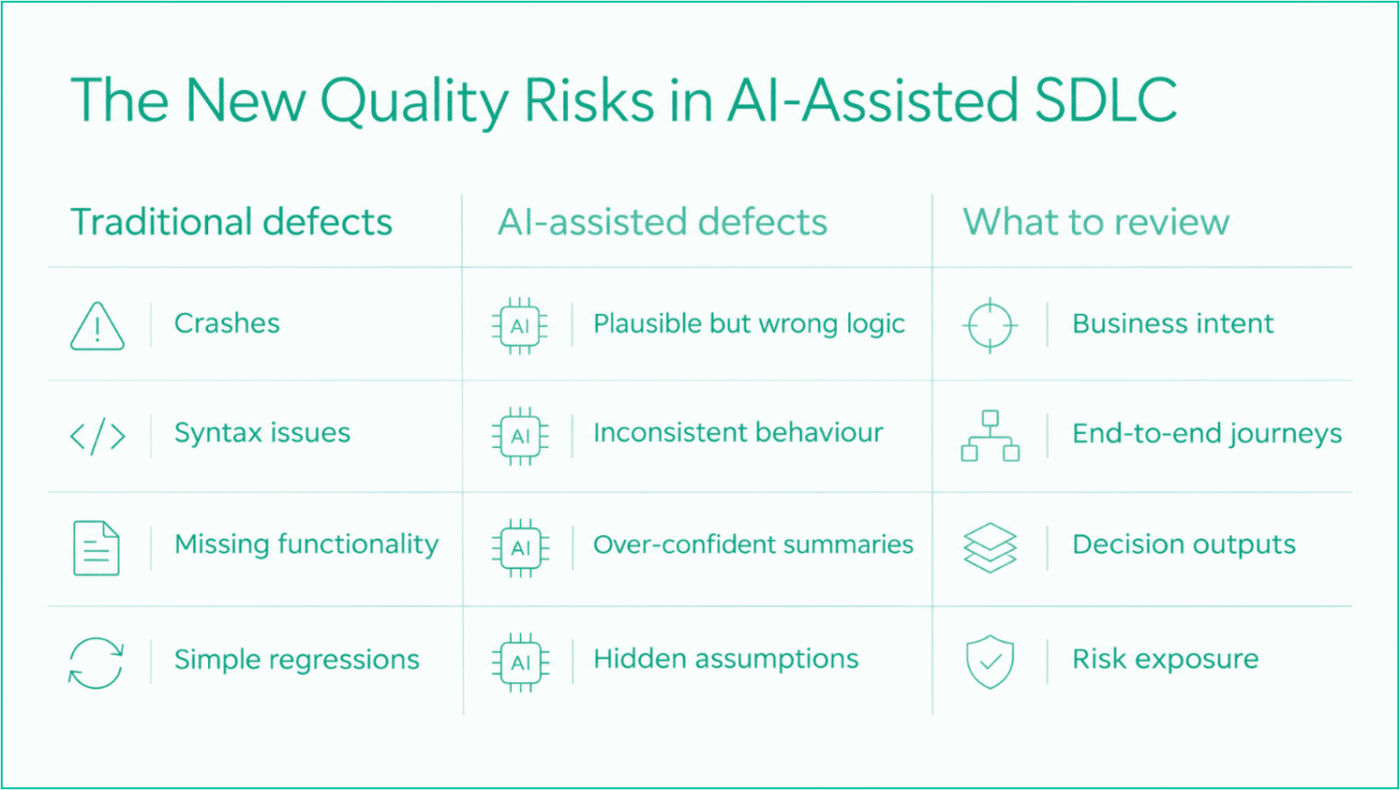
More code means more change per sprint, so more regression risk, and test capacity doesn’t scale at the same rate. The defects I see shift away from typos and obvious crashes, which AI rarely makes, toward subtler issues: logic that is plausible but wrong for this business, inconsistent handling between similar features, and weak error handling. The code compiles, passes its own unit tests, and still does the wrong thing.

The process and the team

Some companies think AI will let them reduce testing or replace testers. What has actually happened?

Where I’ve worked, teams that cut testers saw the number of tests go up and confidence go down. Developers using AI produce lots of tests, but mostly confirming what they built, not challenging it, the tester’s independent viewpoint disappears. What works is a smaller number of more senior testers, focused on strategy, risk and review, with AI absorbing the repetitive production work. That’s a change of profile, not an elimination.

The profession

Which tester skills have become more valuable, and which less important?

More valuable: risk analysis, domain knowledge, critical review, test design techniques (you need them to judge what AI proposes), and the ability to explain a quality risk to a manager. Also a new one: knowing how to instruct and constrain a model, giving it context, rules and examples. Less important: writing test steps by hand, manual formatting of reports, and memorising tool syntax. The paradox is that fundamentals like boundary analysis matter more, not less, because you can’t review what you don’t understand.

What would you tell a manager who wants to introduce AI into testing tomorrow?

First: pick one painful, measurable problem (story quality, test design time, failure triage) and measure the baseline before you start. Second: settle data governance up front: where data goes, which model, under whose keys. Third: keep a human review step and train people in it. Avoid: buying a tool before defining the problem, measuring success by number of tests generated, and cutting testers in the same quarter you introduce AI. You’d lose the people who know whether the output is any good.

Looking ahead

Is there a story from your own work that sums up how AI is changing quality?

While building an AI-assisted reporting tool for Azure DevOps, the generated executive summary of a test campaign read “overall quality is satisfactory” directly above a NO-GO verdict computed from the actual results. Every sentence was well written. It was simply wrong, and a busy manager reading only the summary would have shipped. We fixed it so the narrative can never contradict the data. For me that’s the whole story: AI writes fluently, and the tester’s job is to make sure fluent is also true.

One of the most important takeaways from this interview is that AI does not reduce the need for quality. It shifts its centre of gravity. Where teams once spent a significant portion of their time producing code, tests, or documentation, they must now focus on ensuring that what is generated is relevant, consistent, and genuinely aligned with business needs.
The risk is no longer a lack of content or insufficient test coverage. The real risk lies in placing trust too quickly in outputs that appear convincing. As Alexandre Thibaud points out, a fluent, well-written, or technically valid result is not necessarily the right one.

AI enables teams to move faster. Quality remains what allows them to move forward with confidence. It is precisely in balancing acceleration, risk control, and quality assurance that Itecor delivers value.

More insights

Tricentis Transform London 2026: Agentic AI is redefining the boundaries of Quality Engineering


company newsdata & AIquality assurance & testing

October 30, 2026

Upcoming Itecor Testing Breakfast – AI for Software Quality and Value Creation


data & AIquality assurance & testing

October 12, 2026
Rejoignez Itecor au Swiss IT Forum(s) 2026


digital solutionsgovernance & service managementquality assurance & testing

August 24, 2026