
HomeinsightsAIOps and observability: when AI automatically detects problems in production
quality assurance & testing

AIOps and observability: when AI automatically detects problems in production

Danny Kruoch - Observability Tech Lead Itecor Paris · May 18, 2026

Traditional infrastructure management has reached its limits. When the information system is the core of the business, every minute of downtime comes at a high cost: an average of $14,056 per minute, up to $23,750 for large organizations, and more than 90% of companies estimate that one hour of outage costs them at least $300,000 (EMA Research & ITIC, 2024).

Given this reality, continuing to monitor infrastructures manually, with static thresholds and manual actions, is no longer sustainable.

This is where AIOps comes in – not as yet another technological trend, but as a concrete response to a problem that is costly, exhausting for teams, and growing as architectures become more complex. For SRE (Site Reliability Engineering) teams, AI becomes the copilot that never sleeps, never tires, and sees what humans can no longer detect on their own.

observability: managing complexity

The shift to the cloud and microservices has turned infrastructures into giant puzzles. This fragmentation creates three major challenges:

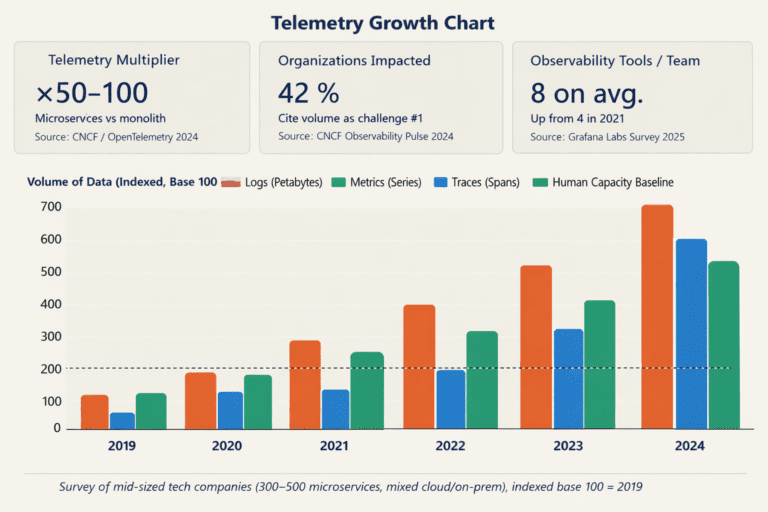
Exponential Growth of Data Flows

System fragmentation mechanically multiplies the amount of data produced by each service. This proliferation of signals (logs, metrics, traces) leads to information overload and makes analysis increasingly difficult.

Human Fragmentation

With responsibilities spread across multiple teams, maintaining a global view of system health becomes a daily challenge.

Data Silos

Information is dispersed across services and regions, making incident correlation slow and complex.

Understanding the System: The Three Pillars of Observability

Observability makes it possible to infer the state of a complex system by analyzing three complementary data streams:

The volume of data generated today exceeds human analytical capacity. For a typical SaaS service, the numbers are staggering:

This overload leads to alert fatigue. The critical signal — the one that indicates a real outage — is often buried in constant technical noise, making the work of SRE and DevOps teams exhausting and imprecise.

AIOps:

a lever for operational performance

AIOps acts as an intelligent layer that transforms incident management by shifting from manual analysis to automated response.

Large‑Scale Analysis and Correlation

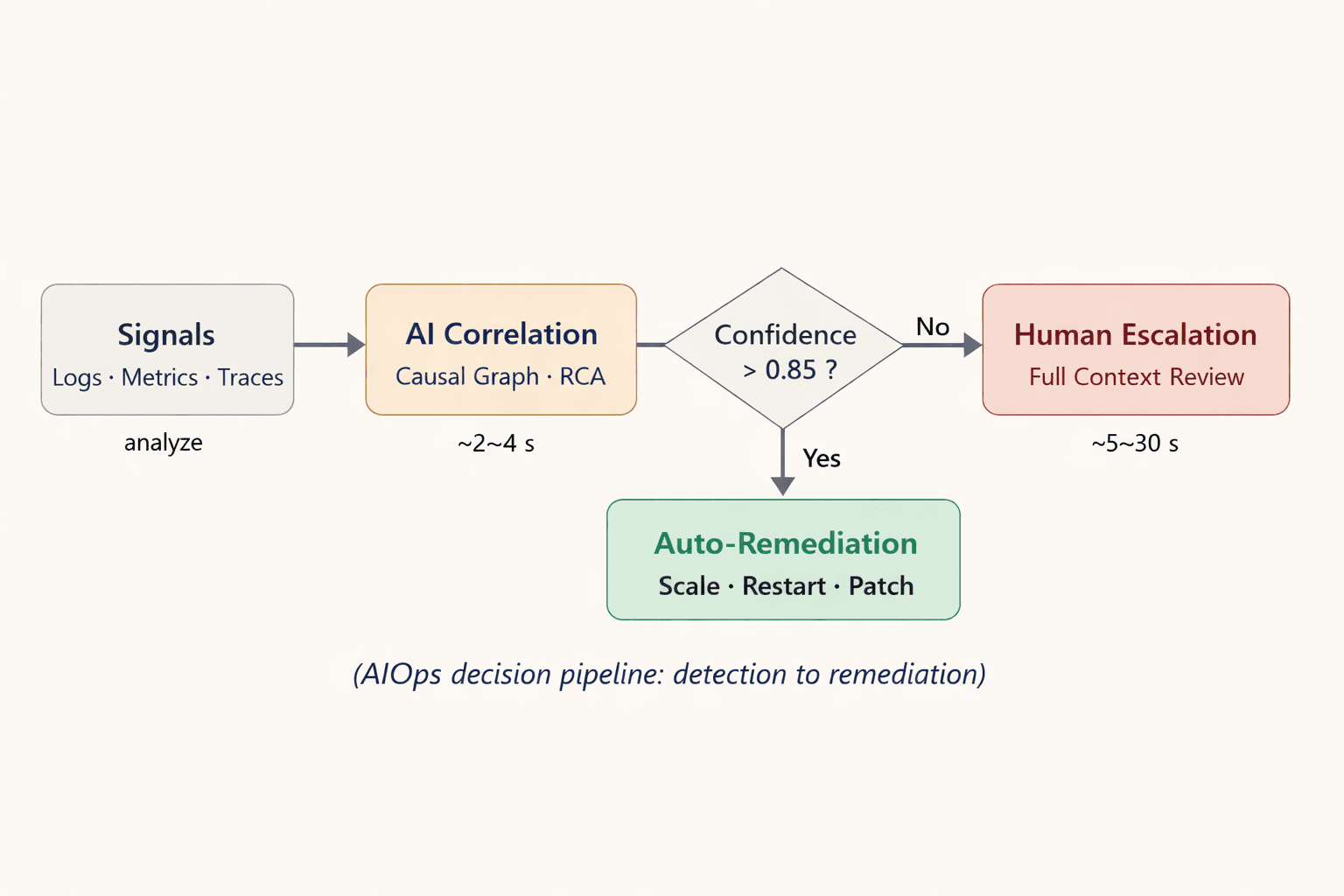
Where humans are limited in their ability to cross‑reference information, AI analyzes thousands of streams simultaneously (metrics, logs, traces). It goes beyond fixed thresholds and identifies links between isolated events to detect complex failure patterns invisible to traditional tools.

Preventive Detection of Weak Signals

AIOps excels at identifying marginal anomalies that precede major outages. By analysing behavioural drifts – such as a slight increase in latency or an unusual drop in calls to a service – the system alerts teams before the end user feels any impact.

Faster Diagnosis

One of the major benefits is the automation of Root Cause Analysis (RCA). Instead of mobilizing several experts, AI gathers technical evidence in real time and directly identifies the failing component. This precision drastically reduces MTTR (Mean Time to Repair) and frees teams from repetitive tasks.

A study published on Research Square shows that AIOps adoption improves incident detection by 35%, diagnostic accuracy by 25%, and reduces MTTR by 40% (Research Square, 2025).

A New Approach to Post‑Mortems and Incident Learning

Post‑mortems become a driver of continuous improvement through three pillars:

Factual Objectivity

AI automatically generates a precise incident timeline, without the omissions or biases of manual reports.

Dynamic Learning

Each resolved incident enriches a knowledge base. The system learns from past diagnostics to accelerate future resolutions.

A Culture of Transparency

Clear, detailed reports facilitate communication with stakeholders, demonstrating that the incident is under control and that preventive measures are in place.

Humans at the Center

AI does not replace engineers – it acts as a copilot. It processes massive amounts of data to provide evidence, but human teams define long‑term corrective actions. The performance of AI remains inseparable from the quality of the underlying observability: without reliable input data, analysis is ineffective.

deployment and proactive operations

A progressive implementation

AIOps adoption is not a sudden replacement but a gradual enhancement of the system. It typically follows three key phases:

Shadow Mode

For 2 to 4 weeks, AI analyses data streams without triggering alerts, calibrating its models and avoiding false positives.

Noise Reduction

Once stable, AI begins grouping similar alerts to present a single consolidated incident to teams.

Low‑Level Automation

Automatic remediation is introduced for simple, repetitive tasks (e.g., restarting a saturated service).

Toward a Proactive and Predictive Strategy

The full potential of AIOps lies in its ability to transform incident management from reactive to anticipatory. For mature organizations, identifying an imminent failure and intervening before any user impact is now operational reality.

Forecasting and Capacity Management

Predictive models such as Prophet, SARIMA, or LSTM help anticipate saturation of critical resources. By projecting time‑series evolution, the system can trigger preventive provisioning long before a service disruption.

Change Impact Analysis

AIOps systematically correlates deployment events (releases, configuration changes) with infrastructure stability.

Change Impact Score

By cross‑referencing these data streams in real time, the system generates a risk score for each modification. This indicator helps assess the danger of a deployment instantly and speeds up decision‑making when performance drifts occur.

Netflix Telltale

Netflix applied this philosophy with its in‑house solution, Telltale. The system does not monitor outages – it anticipates them. By correlating degradation signals across hundreds of microservices in real time, it predicts user impact before any traditional alert is triggered.

Even more impressively, it does not simply recognise previously seen incidents. It reasons using causal models learned from past events, enabling it to handle entirely new configurations.

AIOps does not replace human expertise but amplifies it. By automating the analysis of big data, it frees up time for engineers (SRE/DevOps) so they can focus on architecture and continuous system improvement.

AI as the reliability copilot

AIOps is neither a passing trend nor a marketing promise. It is the structural answer to a fundamental problem: the complexity of modern systems has surpassed human capacity for real‑time supervision. The sheer volume of data, the speed of change, and the interconnection of services make any purely manual approach impossible at scale.

That said, AIOps is not a magic solution. Its effectiveness depends directly on the quality of input data, the rigor of the learning phase, and the commitment of teams to provide continuous feedback. An AIOps tool deployed on poor observability will inevitably deliver poor results.

The trajectory is clear: SRE and DevOps teams that adopt this approach – starting by reducing noise, progressively automating low‑risk remediations, and ultimately aiming for predictive analysis – gain operational serenity, reduce MTTR, and free cognitive bandwidth for what truly matters: building more resilient systems.

The ultimate goal is not to replace human intelligence, but to amplify it where it is most valuable.

Forecasting and Capacity Management

Using predictive models such as Prophet, SARIMA, or LSTM makes it possible to anticipate saturation of critical resources. By projecting the evolution of time‑series data, the system can trigger preventive provisioning well before a service disruption occurs.

Change Impact Analysis

AIOps systematically correlates deployment events – releases, configuration changes – with infrastructure stability.

Change Impact Score

By cross‑referencing these data streams in real time, the system generates a risk score for each modification. This indicator allows teams to instantly assess the potential danger of a deployment and accelerate decision‑making when performance begins to drift.

More insights

from zero to 100 tests in two days with AI


quality assurance & testing

May 18, 2026

itecor paris team recognised at tricentis partner awards 2026


company newsquality assurance & testing

March 25, 2026

beyond expertise: how a consultant makes a real difference


digital solutionsgovernance & service managementquality assurance & testingworking@itecor

October 15, 2025

Contact us